
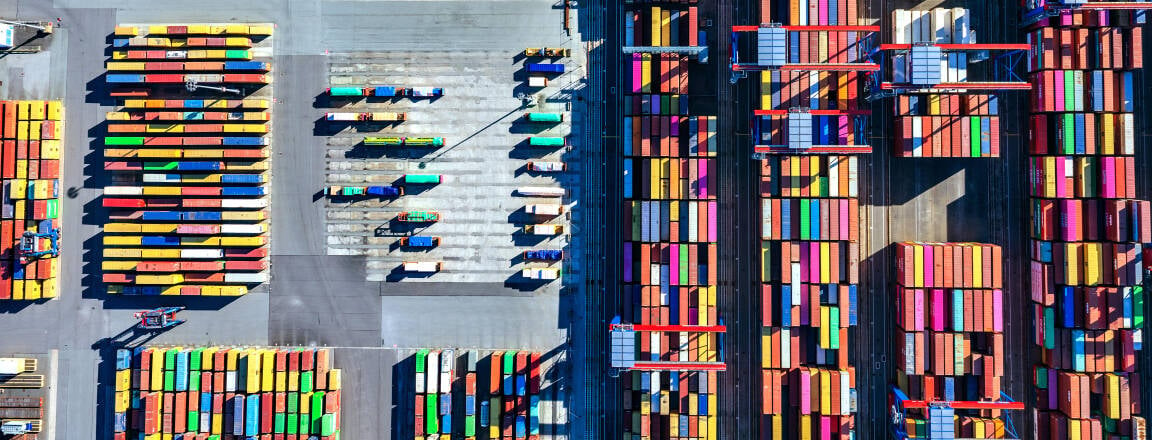
The automated storage blocks at HHLA’s container terminal Burchardkai in Hamburg (right) are significantly more energy-efficient and environmentally friendly than the straddle carriers shown on the left.
Hamburger Hafen und Logistik AG (HHLA) is at the forefront of the transition to electric mobility. Its Container Terminal Altenwerder in the Port of Hamburg has already been operating highly efficient equipment powered by renewable electricity for years. This concept is now being rolled out to other terminals.
The issue is also gaining momentum politically. Speaking at the 2026 Petersberg Climate Dialogue, Germany’s Federal Minister for the Environment, Carsten Schneider, emphasised the need to advance electrification in international climate policy. He said this was a “global megatrend” with rapidly growing markets. HHLA recognised this trend early on and incorporated it into a long-term climate strategy aimed at reducing carbon emissions. The European logistics company headquartered in Hamburg has already reduced its specific CO2 emissions at its container terminals by 58.5 percent since 2008. How has it achieved this? Through increasingly electrified systems and processes powered by renewable electricity from certified sources.
This has been the case for all of HHLA’s sites in Hamburg since 2024. The huge container gantry cranes at the berths have been designed to operate on a continuous direct power supply for decades. The situation is similar at CTA, where rail-mounted gantry cranes are used.
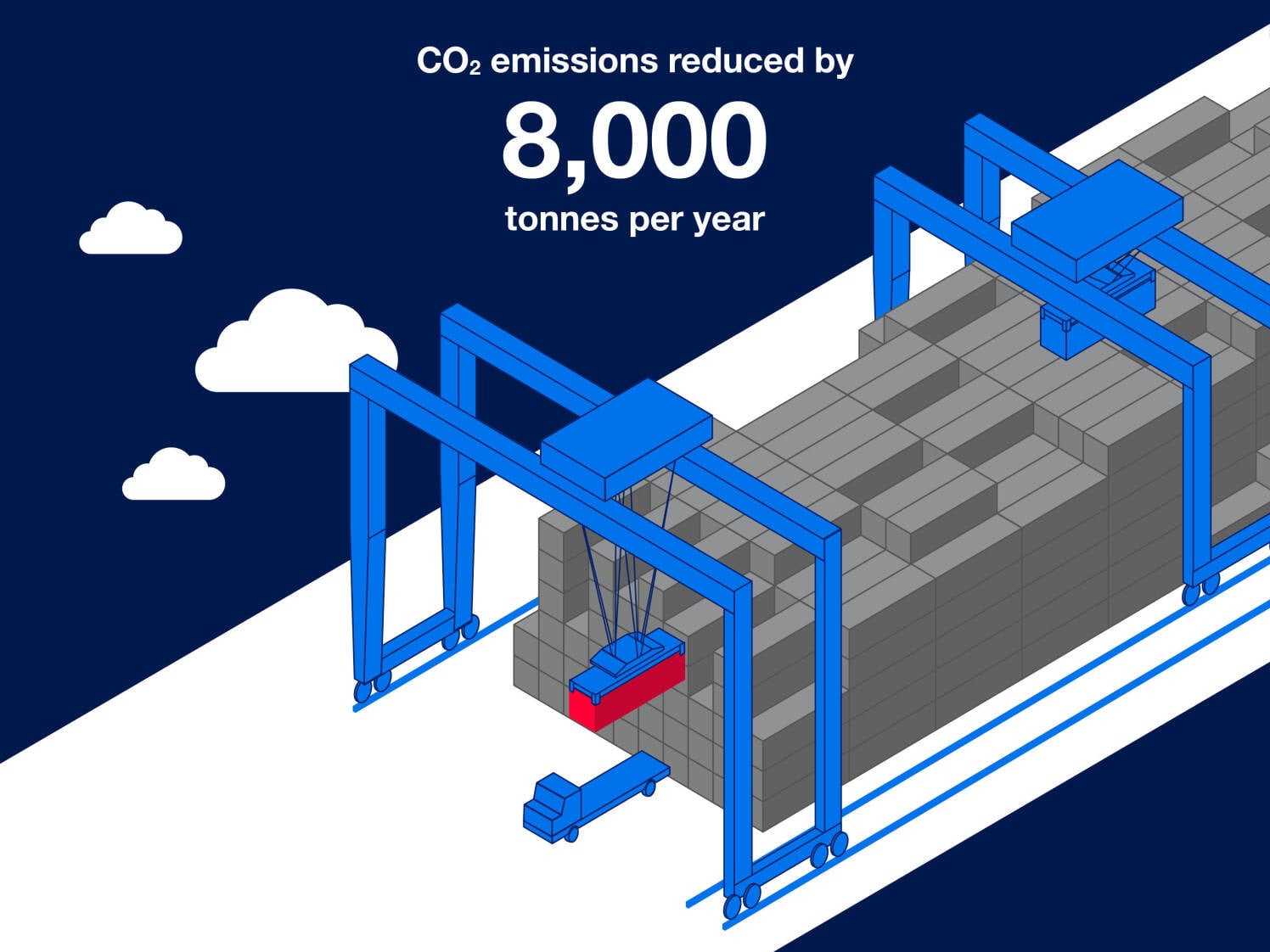
At the Burchardkai terminal's (CTB) container yard, a block storage system is also increasingly replacing diesel-powered straddle carriers. This new system has almost doubled the storage capacity and made container storage more energy-efficient and environmentally friendly. A comparison between the initial phase in 2010 and operations in 2025 illustrates the impacts: for similar throughput figures, diesel consumption fell by around three million litres – saving approx. 8,000 tonnes of CO2.
The switch from straddle carriers to automated guided vehicles (AGVs) is also well underway at CTB. Its sister terminal, HHLA’s container terminal Altenwerder (CTA), is a global pioneer in this technology. The prototype for today’s standard electric automated guided vehicle was developed in collaboration with the German manufacturer Gottwald for CTA. All AGVs there have been battery-powered since 2023. This has saved up to six million litres of diesel at CTA.
The battery-powered AGVs (first tested in 2009) are more environmentally friendly and less prone to faults. They are also much easier to service, as many components – such as the diesel engine, generator, rectifier and motor control system – are no longer required. Overall efficiency is an important metric for technical transport concepts, indicating how much the energy used is converted into motion. From around 25 percent overall efficiency for a diesel-electric AGV, this figure has been improved to more than 70 percent for a battery-electric AGV. This shows the economic principle underlying the transition to electric mobility: the direct use of electricity enables greater efficiency.
First tested in 2009, the battery-powered AGVs are more environmentally friendly and more reliable in operation.
As almost all equipment at CTA is now electric, workshop operations have become cleaner and quieter. “Instead of adjusting valves and relying on intuition and experience to find faults, we’re now measuring insulation values and using diagnostic tools to analyse system log files,” said team leader Sebastian Thiess, describing how the work has changed. He also mentioned that the new generation of lithium batteries (NMC cells) offer greater performance and the battery management system is more reliable.
Battery-powered operation offers additional advantages in places like Hamburg, where the port is located close to the city. Local emissions – including CO2, soot and nitrogen oxides – are completely eliminated. And with no diesel engine required, the noise level is considerably lower. The same applies to HHLA’s large fleet of cars and vans to transport employees and visitors, most of which are now electrified.
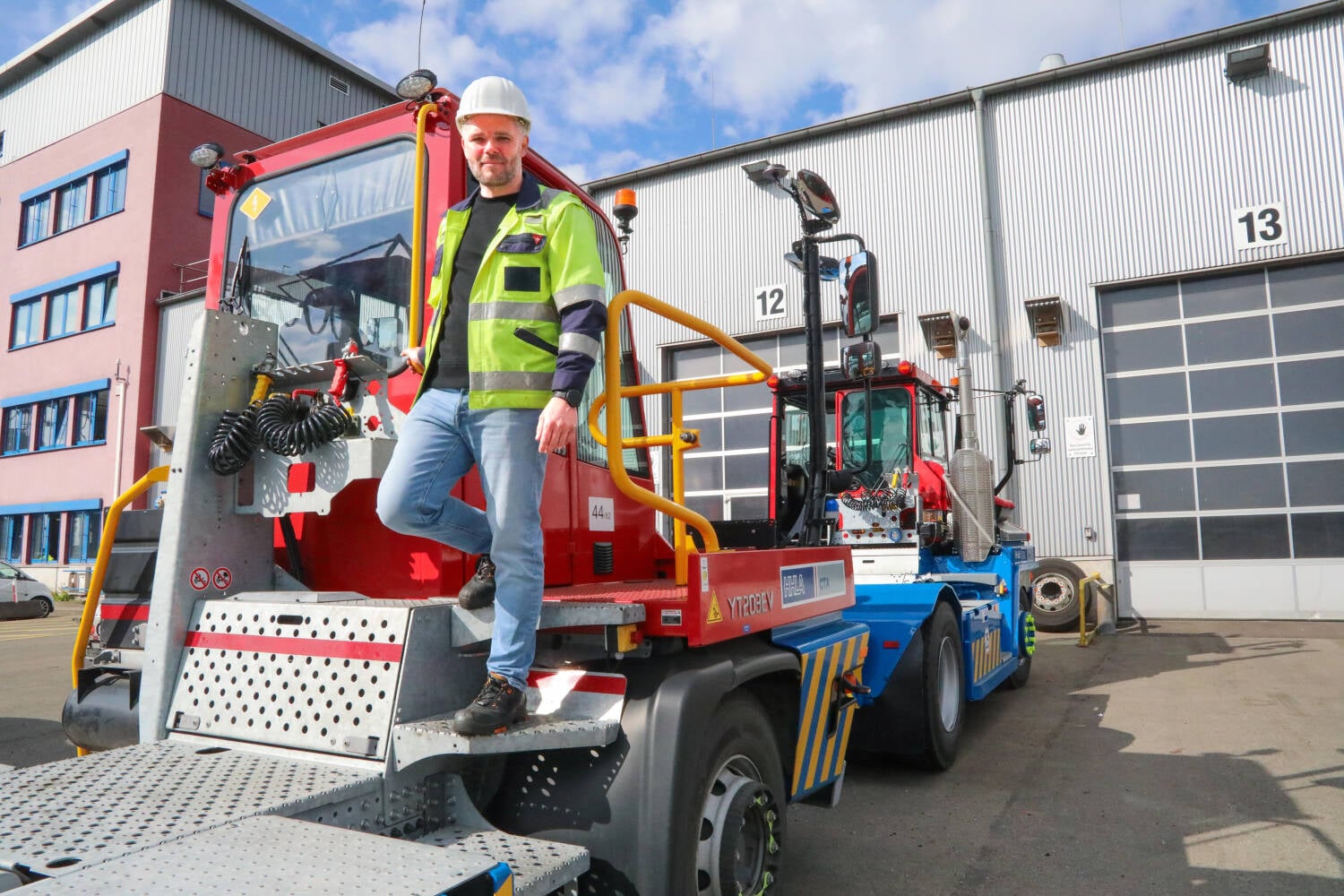
At HHLA’s container terminal Altenwerder (CTA), team leader Sebastian Thies inspects a battery-powered tractor.
While most of CTA’s heavily used tractor units already run on battery power, battery-powered hoists are still being tested at a number of HHLA terminals. The transition to electrically powered machines and processes is therefore being driven forward in various projects. Through these efforts, HHLA is targeting at least a 90 percent reduction in Scope 1 and Scope 2 emissions at Group level by 2040. An ambitious yet logical goal that aligns with the environmental principals underpinning HHLA's business model.

Created on 15 May 2026
Author: Christian Lorenz, Editor in chief at HHLA
While most of CTA’s heavily used tractor units already run on battery power, battery-powered hoists are still being tested at a number of HHLA terminals. The transition to electrically powered machines and processes is therefore being driven forward in various projects. Through these efforts, HHLA is targeting at least a 90 percent reduction in Scope 1 and Scope 2 emissions at Group level by 2040. An ambitious yet logical goal that aligns with the environmental principals underpinning HHLA's business model.
At HHLA’s container terminal Altenwerder (CTA), team leader Sebastian Thies inspects a battery-powered tractor.
Battery-powered operation offers additional advantages in places like Hamburg, where the port is located close to the city. Local emissions – including CO2, soot and nitrogen oxides – are completely eliminated. And with no diesel engine required, the noise level is considerably lower. The same applies to HHLA’s large fleet of cars and vans to transport employees and visitors, most of which are now electrified.
As almost all equipment at CTA is now electric, workshop operations have become cleaner and quieter. “Instead of adjusting valves and relying on intuition and experience to find faults, we’re now measuring insulation values and using diagnostic tools to analyse system log files,” said team leader Sebastian Thiess, describing how the work has changed. He also mentioned that the new generation of lithium batteries (NMC cells) offer greater performance and the battery management system is more reliable.
First tested in 2009, the battery-powered AGVs are more environmentally friendly and more reliable in operation.
The automated storage blocks at HHLA’s container terminal Burchardkai in Hamburg (right) are significantly more energy-efficient and environmentally friendly than the straddle carriers shown on the left.
Hamburger Hafen und Logistik AG (HHLA) is at the forefront of the transition to electric mobility. Its Container Terminal Altenwerder in the Port of Hamburg has already been operating highly efficient equipment powered by renewable electricity for years. This concept is now being rolled out to other terminals.
The issue is also gaining momentum politically. Speaking at the 2026 Petersberg Climate Dialogue, Germany’s Federal Minister for the Environment, Carsten Schneider, emphasised the need to advance electrification in international climate policy. He said this was a “global megatrend” with rapidly growing markets. HHLA recognised this trend early on and incorporated it into a long-term climate strategy aimed at reducing carbon emissions. The European logistics company headquartered in Hamburg has already reduced its specific CO2 emissions at its container terminals by 58.5 percent since 2008. How has it achieved this? Through increasingly electrified systems and processes powered by renewable electricity from certified sources.
This has been the case for all of HHLA’s sites in Hamburg since 2024. The huge container gantry cranes at the berths have been designed to operate on a continuous direct power supply for decades. The situation is similar at CTA, where rail-mounted gantry cranes are used.
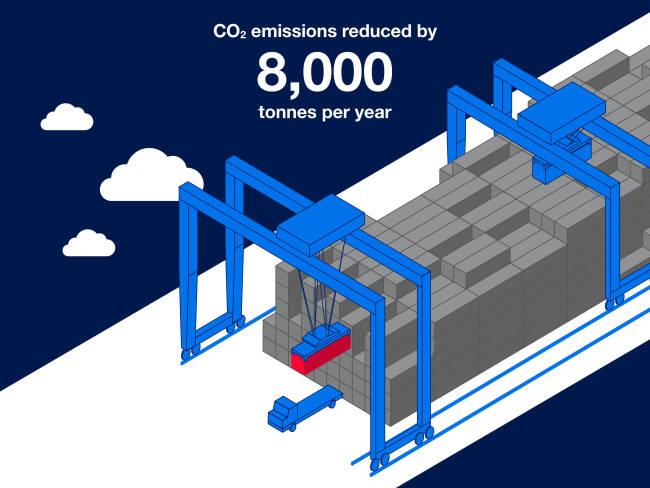
At the Burchardkai terminal's (CTB) container yard, a block storage system is also increasingly replacing diesel-powered straddle carriers. This new system has almost doubled the storage capacity and made container storage more energy-efficient and environmentally friendly. A comparison between the initial phase in 2010 and operations in 2025 illustrates the impacts: for similar throughput figures, diesel consumption fell by around three million litres – saving approx. 8,000 tonnes of CO2.
The switch from straddle carriers to automated guided vehicles (AGVs) is also well underway at CTB. Its sister terminal, HHLA’s container terminal Altenwerder (CTA), is a global pioneer in this technology. The prototype for today’s standard electric automated guided vehicle was developed in collaboration with the German manufacturer Gottwald for CTA. All AGVs there have been battery-powered since 2023. This has saved up to six million litres of diesel at CTA.
The battery-powered AGVs (first tested in 2009) are more environmentally friendly and less prone to faults. They are also much easier to service, as many components – such as the diesel engine, generator, rectifier and motor control system – are no longer required. Overall efficiency is an important metric for technical transport concepts, indicating how much the energy used is converted into motion. From around 25 percent overall efficiency for a diesel-electric AGV, this figure has been improved to more than 70 percent for a battery-electric AGV. This shows the economic principle underlying the transition to electric mobility: the direct use of electricity enables greater efficiency.
Created on 15 May 2026
Author: Christian Lorenz, Editor in chief at HHLA